
Water Damage Near Me in Reno, Sparks & Lake Tahoe
When water enters a home, commercial building, retail property or industrial facility, the location of the restoration company matters. Water continues moving after the original leak or flooding occurs, spreading beneath flooring, behind walls, through insulation and into adjoining areas that may initially appear dry.
Our Reno–Tahoe water damage team provides local response for properties throughout Reno, Sparks, Carson City, Incline Village, Lake Tahoe and surrounding Northern Nevada communities.
From a leaking supply line inside a home to a major commercial building loss, the first objective is the same: identify the source, determine how far the water traveled and begin controlling the damage.
Water extraction is only the beginning.
Proper restoration can involve moisture detection, structural drying, dehumidification, selective demolition, flooring removal, reconstruction and, for commercial properties, coordination with larger tenant improvement or build-back plans.
Emergency Water Damage Restoration Near Reno
Water emergencies rarely occur at convenient times.
A pipe can fail overnight. Roof leaks may become apparent during a storm. Water heaters can release significant amounts of water before anyone discovers the problem. Commercial plumbing failures can affect multiple rooms, floors or tenant spaces.
Fast response helps limit how much of the building becomes involved.
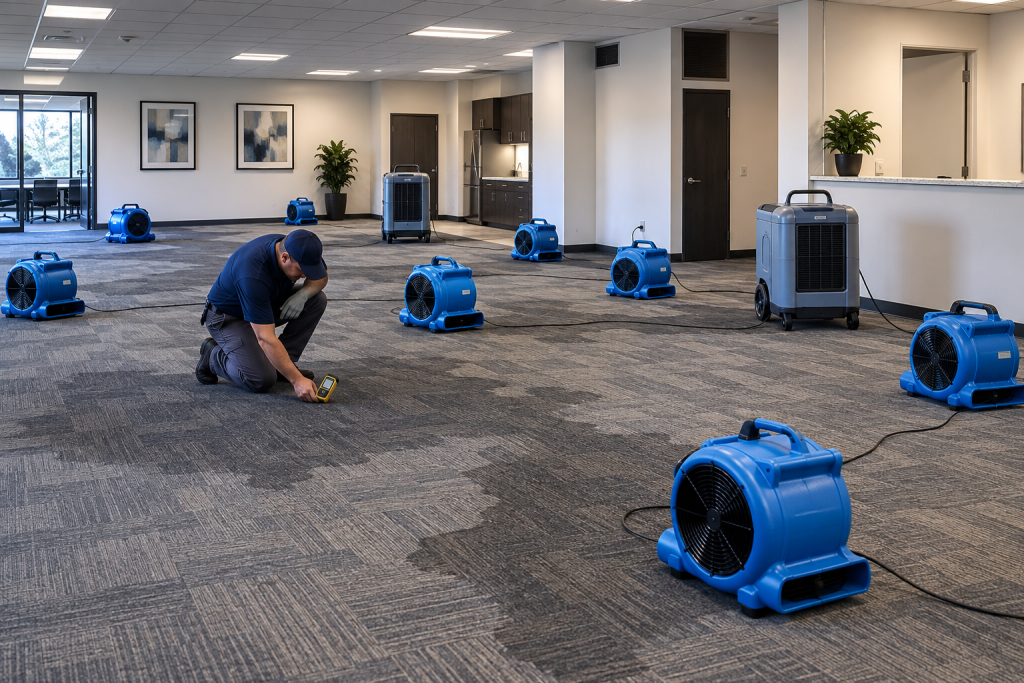
Standing water should be extracted where necessary, but visible water does not tell the entire story. Moisture can migrate beneath flooring systems, enter wall cavities and become trapped inside building materials.
That hidden moisture is one reason professional drying is an important part of water damage restoration.
The goal is not simply to make the floor look dry.
The affected building materials need to be evaluated so the restoration plan addresses the complete loss.
Water Extraction, Drying & Dehumidification
Removing standing water changes the appearance of a flooded room quickly. Drying the structure takes additional work.
Different materials absorb and release moisture differently.
Drywall, wood framing, insulation, carpet, subflooring and concrete assemblies can all respond differently after exposure. Commercial buildings introduce additional materials such as suspended ceilings, wall systems, large floor coverings and specialized finishes.
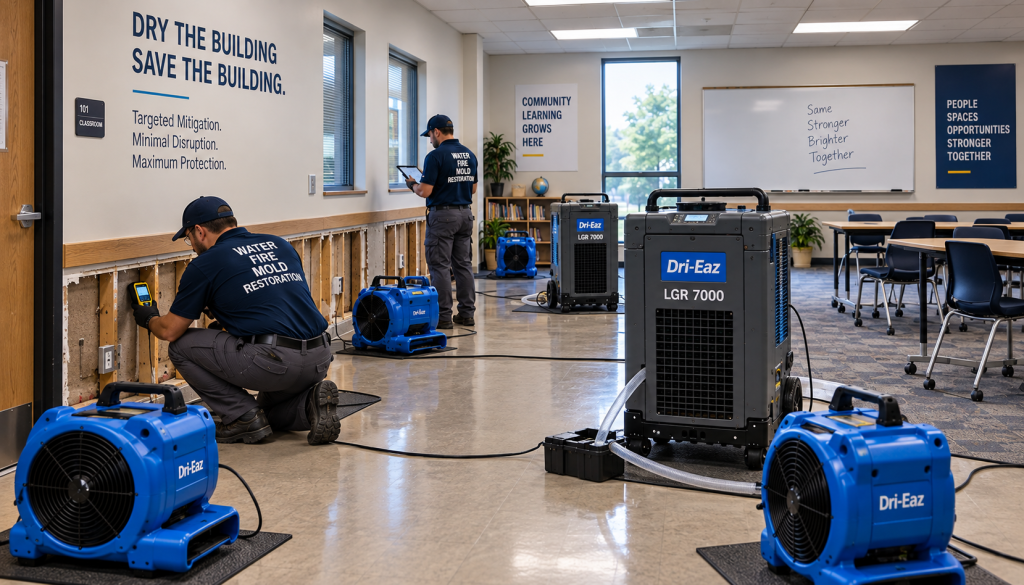
Air movement and dehumidification can then be established around the conditions found at the property.
Some materials may be dried in place.
Others may need to be removed because of contamination, deterioration or the inability to dry the assembly effectively.
Making that distinction early can prevent unnecessary demolition while ensuring damaged materials are not simply covered during reconstruction.
Commercial Water Damage Near Me
A flooded commercial building creates problems that extend well beyond damaged walls and flooring.
Business operations may be interrupted. Employees and customers can lose access to parts of the property. Inventory, equipment and furniture may need to be relocated. Property managers must often coordinate restoration activities with tenants, building engineers and contractors.
Large commercial spaces can also allow water to travel considerable distances before the full extent of the loss becomes apparent.
Warehouses may experience water migration across large floor areas. Office buildings can have damage above ceilings and inside wall cavities. Retail properties may need restoration performed around merchandise and customer areas. Hotels and multifamily properties can experience water movement between rooms or floors.
Commercial restoration therefore requires a building-wide perspective.
Our Reno–Tahoe service area includes water damage response for offices, retail stores, warehouses, industrial buildings, restaurants, medical facilities, hospitality properties and other commercial environments.
Retail Water Damage in Reno & Sparks
Retail water damage creates a unique restoration challenge because every day of disruption can affect revenue.
A relatively small plumbing failure can damage flooring, drywall, displays and inventory while also forcing portions of the store to close.
Restoration planning should consider how the business operates.
When conditions permit, affected areas may be isolated while other portions of the property remain usable. Construction barriers, drying equipment placement and material removal can be planned around customer and employee access.
Flooring deserves particular attention.
Water can migrate underneath carpet tile, resilient flooring and other commercial floor coverings. Surface appearance alone may not reveal what is happening underneath.
Evaluating the flooring assembly and substrate helps determine whether drying, partial replacement or a broader flooring restoration is appropriate.
Office Building Water Damage
Office water losses frequently involve more than one building system.
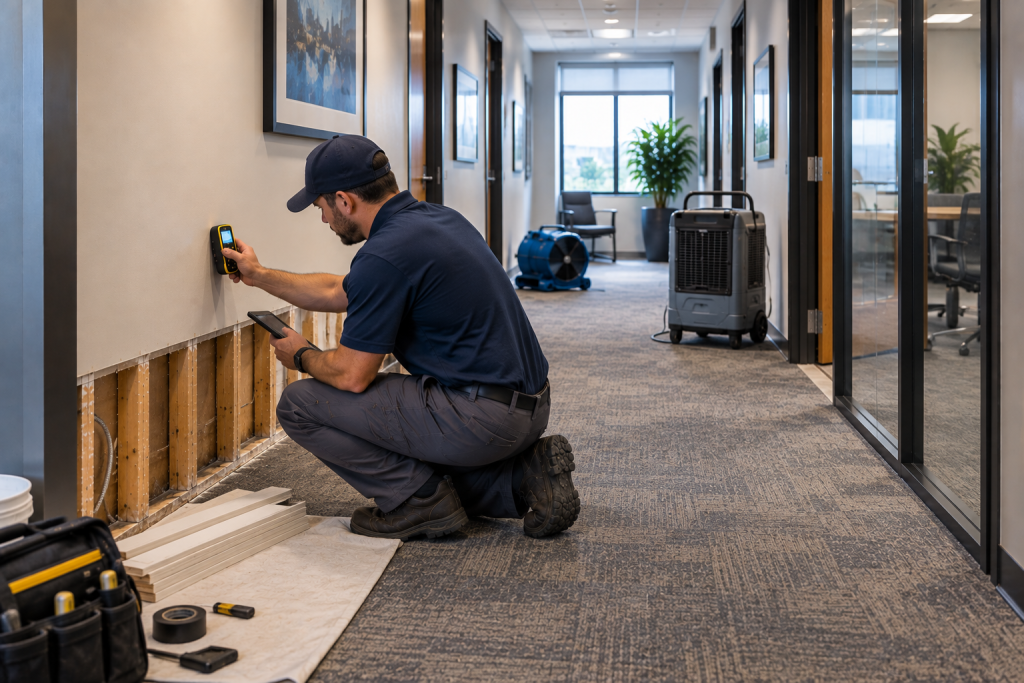
Water from a plumbing failure may travel above suspended ceilings before appearing inside offices. Wet ceiling tiles can be the first visible sign even though moisture has already reached insulation, drywall or flooring elsewhere.
Mechanical rooms, breakrooms and restrooms can create additional loss scenarios.
Once affected materials are identified, the restoration plan should consider how employees use the building.
Conference rooms, reception areas, private offices and common spaces may need to remain accessible during portions of the work.
Phased restoration can sometimes help maintain business operations while damaged areas are being dried and reconstructed.
Warehouse & Industrial Water Damage
Large commercial and industrial buildings present an entirely different restoration environment.
Floor area can be substantial. Roof drainage failures, sprinkler problems, broken water lines or equipment-related leaks may release water across production and storage areas.
Inventory and machinery add another layer of complexity.
Protecting unaffected assets can become just as important as removing water from the damaged portion of the building.
Industrial flooring should also be evaluated after a significant loss. Coatings, joints and underlying concrete conditions may require inspection before the area returns to normal service.
The restoration strategy should reflect how the facility actually operates rather than treating a warehouse like an oversized residential loss.
Lake Tahoe & Incline Village Water Damage
Mountain properties face water damage conditions that differ from those found in the Reno valley.
Snow accumulation, freezing temperatures, seasonal occupancy and winter plumbing failures can all influence when a water loss is discovered and how severe it becomes.
A broken pipe inside an occupied property may be noticed quickly.
The same failure inside a seasonal residence or temporarily vacant property can continue much longer before discovery.
Lake Tahoe and Incline Village properties can also contain complex rooflines, multiple levels, wood construction and premium interior finishes that require careful evaluation following water intrusion.
Access and weather conditions may further influence restoration planning.
Local experience matters because a Tahoe water loss is not always simply a Reno water loss at a higher elevation.
Water Damage Reconstruction & Build-Back
Drying the building is not always the end of the project.
Significant losses may require drywall replacement, painting, flooring installation, ceiling repairs, trim work, cabinetry or other reconstruction.
Commercial properties can involve considerably larger build-back scopes.
Walls may need to be reconstructed. Suspended ceilings can require repair. Electrical components may need evaluation. HVAC distribution can be affected by changes above ceilings or inside walls.
Planning reconstruction early creates a smoother transition from mitigation into recovery.
It also provides an opportunity to evaluate whether the damaged space should simply be recreated exactly as it existed.
Tenant Improvements After Commercial Water Damage
Major commercial water damage can overlap directly with tenant improvement construction.
Once flooring, drywall, ceilings or interior partitions have already been removed, rebuilding an outdated layout only to remodel it again later may not make financial sense.
Property owners and tenants can instead evaluate the future use of the space before reconstruction begins.
An office might need a different conference room configuration. Retail tenants could want a redesigned sales floor. Restaurants may require new finishes or utility modifications. A second-generation commercial suite might already have been scheduled for renovation before the water loss occurred.
Coordinating the restoration scope with the planned tenant improvement can reduce duplicated demolition and construction.
The sequence becomes:
Water mitigation → structural drying → damage assessment → TI planning → commercial build-back.
That approach turns reconstruction into part of the property’s next stage rather than simply recreating an interior that no longer meets the tenant’s needs.
Flooring Replacement After Water Damage
Flooring is frequently one of the largest finish decisions following a water loss.
Carpet and pad can hold moisture. Wood products may swell or distort. Commercial flooring can trap moisture underneath the finished surface. Adhesives may also be affected.
Replacement decisions should consider the future use of the space.
A commercial garage, warehouse, service facility or back-of-house environment might benefit from a durable epoxy flooring system during reconstruction. Retail and office properties may require entirely different finishes.
Substrate preparation remains important regardless of the material selected.
Installing a new floor before underlying conditions are properly addressed can create another problem rather than completing the restoration.
Signs You May Have Hidden Water Damage
Not every water loss begins with several inches of standing water.
Some develop gradually.
Discolored drywall, bubbling paint, warped flooring, staining around ceilings, musty odors or unexplained changes in building materials can indicate moisture is present somewhere it should not be.
Commercial buildings can be especially difficult because water may travel along structural components or above suspended ceilings before becoming visible.
Finding the source is therefore only one part of the investigation.
Determining where the water traveled is equally important.
Residential Water Damage Restoration
Homes throughout Reno, Sparks, Carson City and the surrounding area can experience water damage from plumbing failures, appliances, roof leaks, bathroom overflows and other unexpected events.
Kitchens and bathrooms are common problem areas because several water connections are concentrated within relatively small spaces.
Laundry rooms and water heaters can also produce substantial losses.
Water reaching adjoining rooms may travel underneath flooring before becoming visible at the surface. Multi-story homes introduce the possibility of water entering ceilings and walls below the original source.
Early evaluation helps establish the actual boundaries of the affected area before repairs begin.
Water Damage Near Reno, Sparks, Carson City & Tahoe
“Water damage near me” means more than finding someone capable of removing standing water.
The restoration company needs to understand the types of buildings found throughout the region and how those properties respond to different kinds of water losses.
Reno commercial buildings create different challenges than Tahoe mountain properties.
Sparks warehouses are different from Incline Village residences.
Downtown offices require a different restoration strategy than industrial facilities, restaurants or retail stores.
Our service area extends throughout Reno, Sparks, Carson City, Incline Village, Lake Tahoe and surrounding Northern Nevada communities.
From Emergency Response to Complete Recovery
The best time to control a water loss is before secondary damage expands the project.
Extraction removes standing water.
Moisture detection helps establish how far the loss extends.
Structural drying addresses affected building materials.
Selective demolition removes materials that cannot reasonably remain.
Reconstruction restores the damaged property.
For commercial buildings, that process can continue into flooring upgrades, tenant improvements and larger build-back projects when the property requires more than basic repairs.
Whether the loss involves a home, retail store, office, warehouse, industrial facility or Tahoe property, the objective is to understand the entire problem before rebuilding begins.
For water damage restoration in Reno, Sparks, Carson City, Incline Village and Lake Tahoe, contact Water Damage Reno at (775) 386-2034.